
BRICS at 20 and Beyond: A Multipolar World Order in the Making?
Post-Summit Webinar 2026
BRICS at 20 and Beyond: A Multipolar World Order in the Making? | Post-Summit Webinar 2026 - Heinrich Böll Stiftung Delhi
 Watch on YouTube
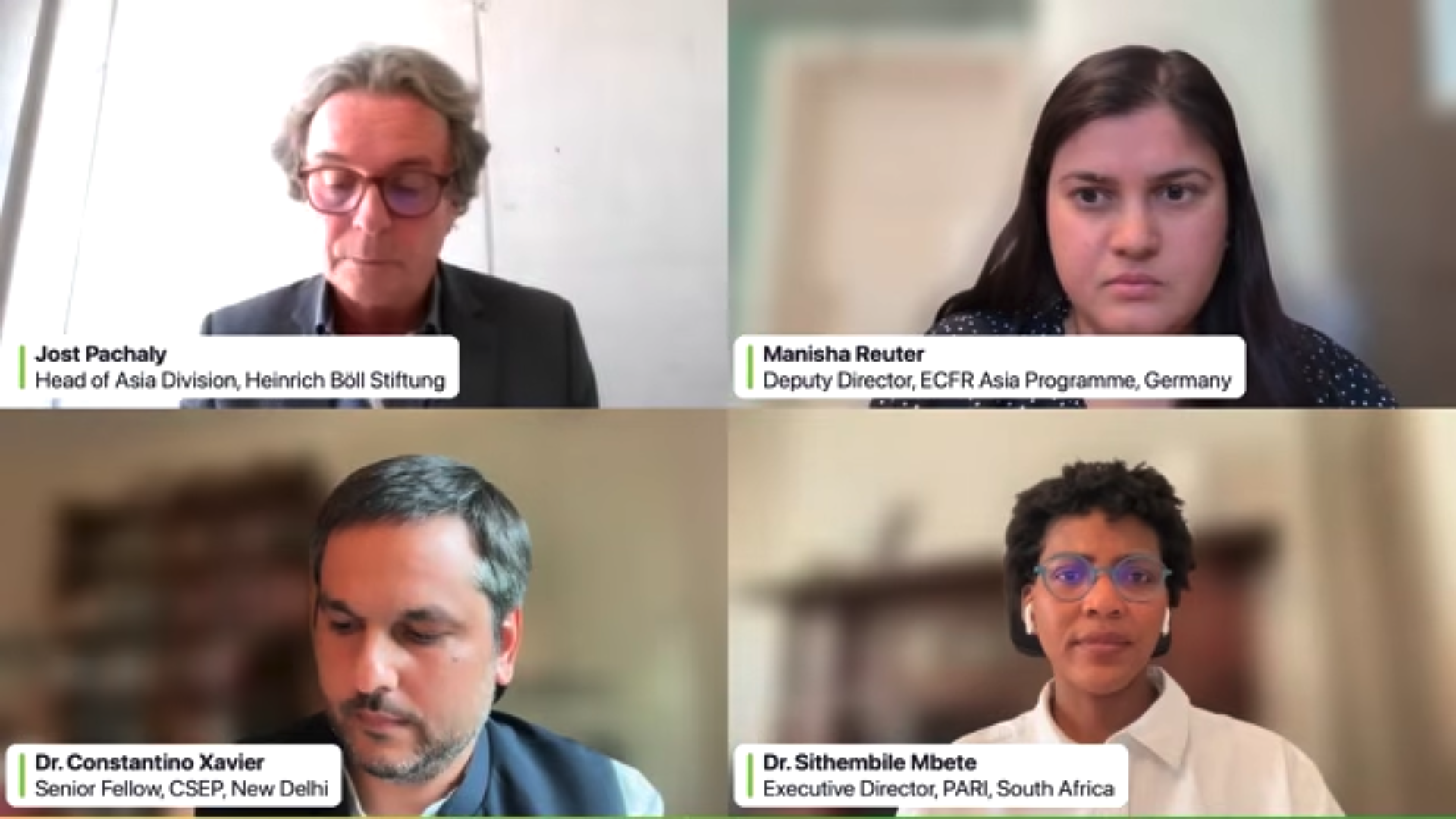
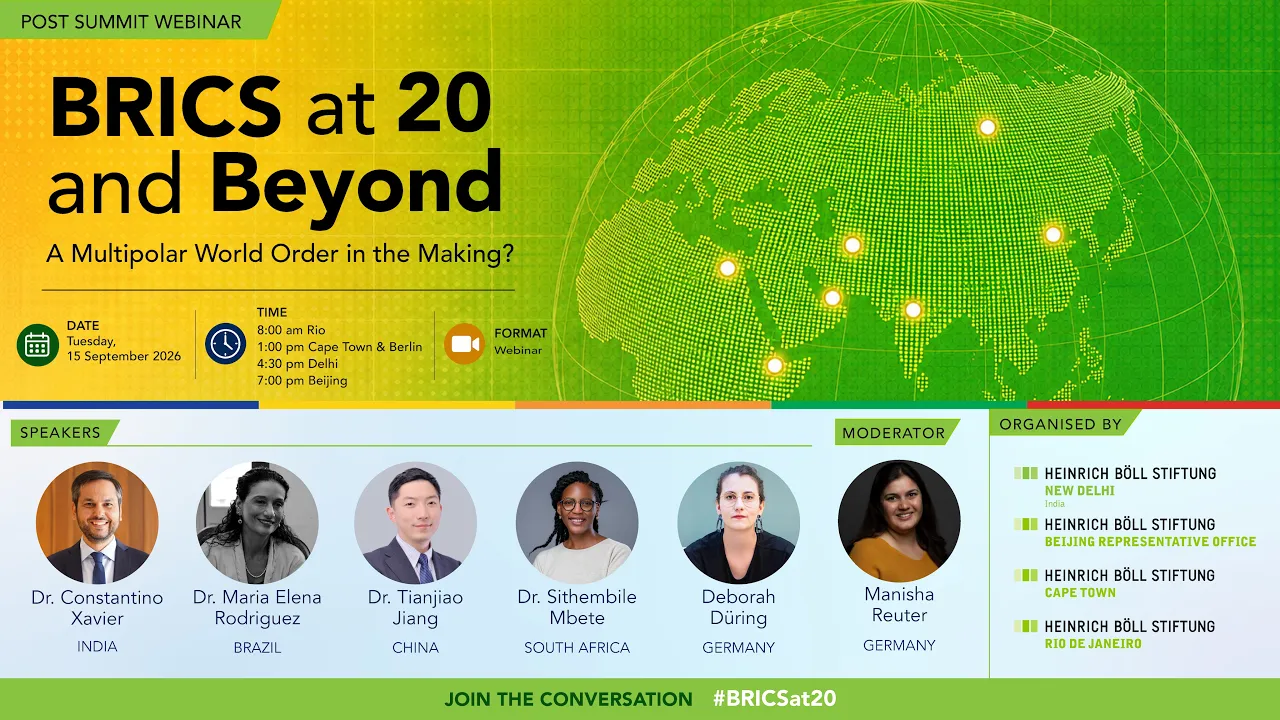
This webinar examined the outcomes of the 2026 BRICS Summit and the grouping’s role 20 years after its creation. It explored what unites its diverse members, BRICS’ significance in the changing international order, and what its evolution means for the Global South and Europe.
Key Insights from the Discussion
- On the weekend of the 12th and 13th of September 11 members of the BRICS grouping convened in New Delhi for the 18th BRICS summit, marking the 20th anniversary of the grouping. Under this year’s theme Building for resilience, innovation, cooperation and sustainability, member states concluded with a 140 paragraphs unanimous declaration.
- The fact that such fundamentally different actors were able to find enough common ground to agree on a joint declaration can be considered a diplomatic achievement in itself. It signals that cooperation across differences remains possible at a time when building consensus on this scale is becoming increasingly challenging. However, consensus could only be reached through the use of carefully chosen language on the Middle East and the silence on certain contentious issues such as conflicts in Africa and the war in Ukraine.
- What unites the grouping is a shared sense of development priorities among member states. From this shared orientation, the grouping’s substantive value also derives from functional cooperation across concrete policy domains, including healthcare, agriculture, water management, digital infrastructure, and development finance.
- Amid increasing contestations and shifts within the current international order, actors in different parts of the world are grappling with how to conceptualize the BRICS grouping and its role. BRICS should neither be understood as a purely symbolic forum without substantive agenda nor as a side for a fundamental restructuring of the world. Reinforcing established principles such as sovereignty and international law, and advocating for their more consistent and equal application rather than contesting these principles as such, BRICS is better characterized as reformist than as revolutionary.
- Twenty years of BRICS reflect a broader shift away from fixed, bloc-based alliances toward more situational, interest-driven partnerships. Many countries, including India, engage simultaneously with multiple, and at times competing, power centers, calibrating cooperation sector by sector rather than committing to a single camp. This logic has become increasingly normalized across much of the Global South, in contrast to the more structured alliance and long-term partnership model still preferred in European capitals. The BRICS grouping and its member states illustrate that multiple competing partnerships are possible and reflect an emerging structural feature of the current international order.
- The forming and expansion of alternative groupings such as BRICS can be read as a symptom of a deeper legitimacy problem within the existing international order, whose institutions still largely reflect a post-war distribution of power that no longer corresponds to today’s realities. For Europe, this carries a clear lesson: It must put forward reforms of multilateral instiutions and take concrete action in tackling global inequalities such as in the area of international debts or climate change. It can no longer assume the role of sole agenda-setter. Instead, it must be increasingly be prepared to lead where appropriate and negotiate, listen and follow where necessary.
The views and analysis contained in this summary are those of the speakers and do not necessarily represent the views of the Heinrich Boell Foundation.


