
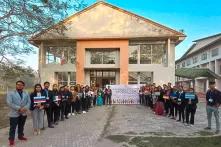
Students from various educational institutions of Assam assembled at the Dibrugarh University to act as various country delegates at the Model G20 session being conducted at Dibrugarh University, February 2023. Photo by the author.
Image credits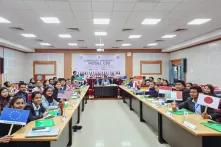
The Model G20 session being conducted at Dibrugarh University, February 2023. For almost all the students it was a unique and new experience. Photo by the author.
Image credits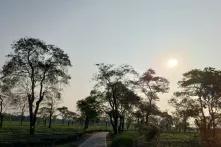
The ‘off beaten’ path to G20! The ‘University Connect’/ Y20 programme took awareness and outreach programme on India’s G20 Presidency to remote corners of the land, where interactive sessions were organised with students ranging from school to post graduate levels. Seen in the photo is the way to a ‘Model Tea Garden School’ in Maijaan , Dibrugarh district, Assam, a site selected for a session on dissemination of information on India’s G20 Presidency. The area where the school is located is amongst the oldest tea estates of the country and primarily inhabited by ‘tea tribes’[i], good road connectivity, reach of internet and stable mobile phone signals being a relatively recent development. (Photo by the author, April, 2023)
[i] Plantation labour brought in by the British for Assam’s growing tea industry, mainly from the central Indian Adivasi belts. This section of indentured ethnic population is referred to as ‘tea tribes’ today.
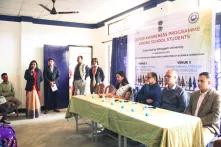
The ‘Awareness Programme Among School Students’ being undertaken at Maijan Tea Garden Model School. The challenges to ‘connect the local with the global’ become most prominent in such places of margins. When one tries to explain the significance of India’s G20 Presidency 2023 to a bunch of upper primary and high school students, an overwhelming number of them being first generation learners with extremely limited access to technology, one begins to realise the potential depths of the doctrines of G20 itself.
Image credits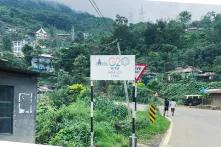
G20 board as seen in the locality of Lerie on the outskirts of Kohima, Nagaland. The fact that particular inscriptions stating in clear terms sentences like “Nagas are not Indians” co-exist these spaces, makes experiences like G20 all the more interesting in such spaces, where signage are a means of claims and appropriations too. An ‘international’ event can thus mean further consolidation of a certain ‘nationalisation of spaces’, looked at from this ‘state-centric’ viewpoint.
Image credits