Article
Nirmala Raja’s work in Rajapalayam shows that a just energy transition is not only about technology and policy, but also about care, restoration and community-centred leadership.

In Rajapalayam, Tamil Nadu, the land holds memory in layers – of cotton and industry, of heat rising from limestone, and of a town shaped as much by enterprise as by ecology. For decades, the city has been known as a textile hub, its growth closely tied to families like Nirmala Raja’s, whose legacy is woven into the region’s industrial fabric.
The Ramco Group, with which her family is closely associated, is a diversified industrial conglomerate with major interests in cement, textiles, and building materials. In and around Rajapalayam, its cement plants and textile mills have long been central to the local economy, shaping patterns of employment, resource use, and urban growth.
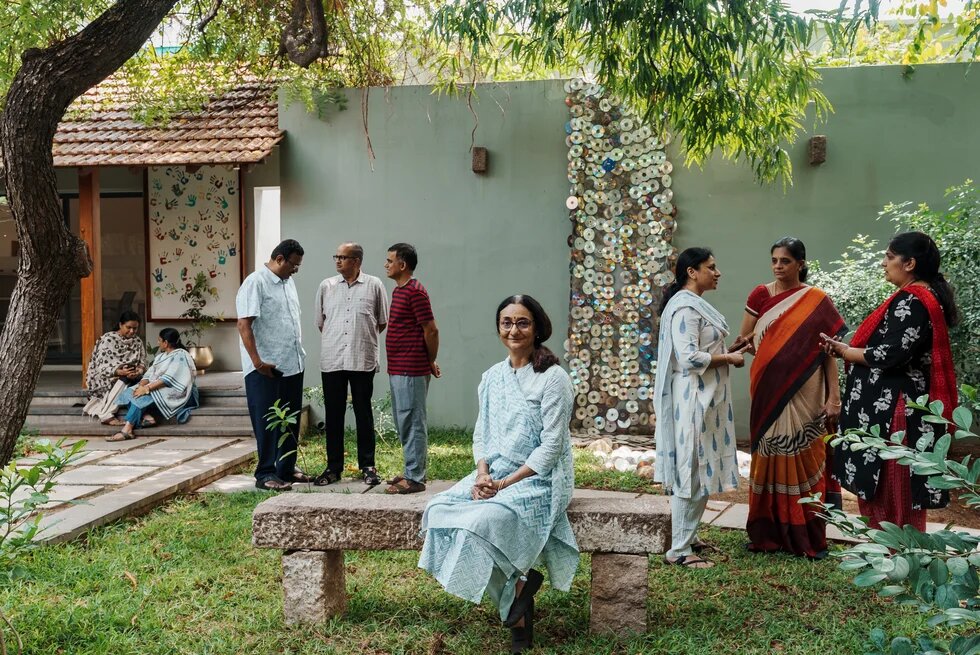
Today, however, another story is beginning to take root here, one that asks what it might mean for a town like this to transform – not just economically, but ecologically and socially. At the centre of this shift is Nirmala Raja, Chairperson of Ramco Community Services – the group’s social development arm – and a member of the governing council of the Tamil Nadu Climate Change Mission.
At the Ramco Community Services, Raja leads initiatives spanning education, healthcare, and livelihoods, while increasingly shaping the group’s engagement with climate action and sustainability in the region. In recent years, her work has focused on rethinking how industrial regions can respond to climate change through locally grounded, community-linked approaches. Her work moves across unlikely intersections – industry and restoration, policy and community, energy systems and emotional wellbeing. It is neither a linear journey nor one confined to a single identity. Instead, it is guided by a quiet adaptability to move between worlds, to listen closely, and to keep learning.
That openness is what stands out most when you speak with her as she moves easily between reflections on childhood, motherhood, and moments of personal rupture as well as conversations about greenhouse gas inventories, rooftop solar, and circular systems. There is no attempt to separate the personal from the professional; rather her leadership seems to emerge from holding both honesty about uncertainty and a willingness to stay with difficult questions.
At a time when the energy transition is often framed in technical terms – megawatts, emissions, infrastructure – her work offers a different lens. It asks what happens when transition is approached not only as a shift in energy systems, but as a process of rebuilding relationships – with land, community, and ourselves. Because without that, transitions risk reproducing the very inequities they seek to address, often excluding small businesses, informal workers, and especially women, whose labour and knowledge remain under-recognised.
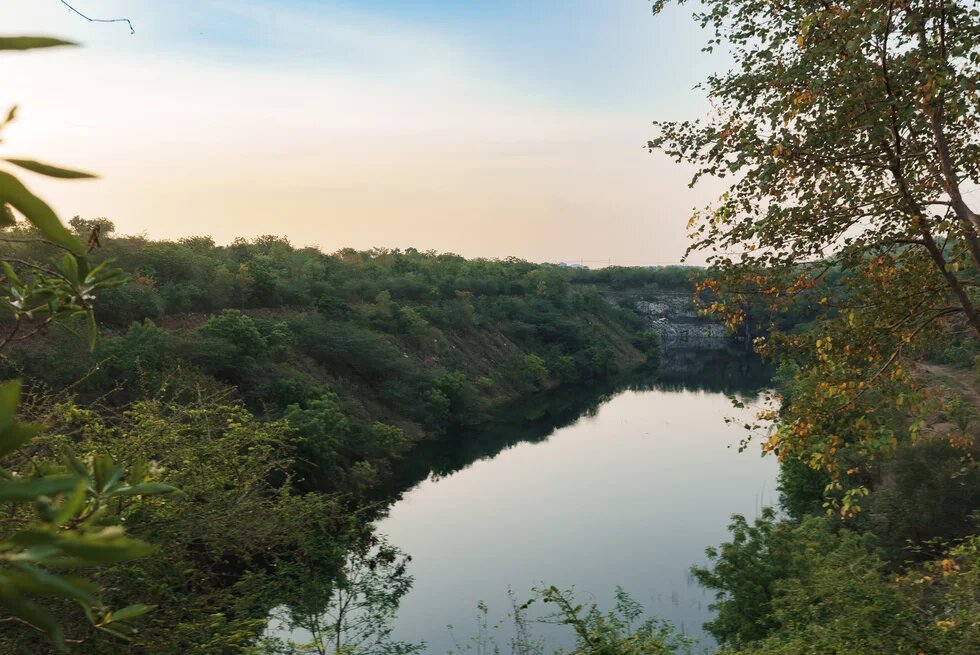
In Rajapalayam, this question is not abstract. It is visible in the transformation of the Pandalgudi limestone mine – once a depleted, extractive landscape, now slowly regenerating into an ecological space. This shift is particularly significant in a region where limestone extraction has historically fuelled the cement industry, linking local ecology directly to industrial production. It is reflected in emerging efforts – detailed greenhouse gas accounting, energy transition planning, and pilots around decentralised renewable energy – to turn Rajapalayam into a low-carbon town. It is also present in the mapping of the town’s emissions, where the quiet, everyday consumption of energy in homes and industries emerges as the largest contributor and where the potential for rooftop solar stretches, quite literally, across every available surface.
Listening to Nirmala, you begin to sense that Rajapalayam is being imagined as more than a site of isolated projects; it holds the possibility of becoming a model for how industrial towns might reorient towards ecological restoration while generating wellbeing for their communities. What she is helping to build is not a single programme, but an evolving, place-based transition framework connecting industry, local government, and communities in rethinking development itself.
What makes that possibility feel real is the way she leads, with attentiveness, adaptability, and a grounded empathy shaped by lived experience. In a transition as vast and uneven as this one, Nirmala’s leadership offers a reminder: Change is not only about new systems, but about how we carry people and their realities through it.
Excerpts from an interview with her:
NEHA SAIGAL
You’ve moved across worlds – rural and urban, India and abroad – and stepped into very different roles over time. When you look back, what feels like the thread that has shaped your journey?
NIRMALA RAJA
I often feel like my life has been a movement between different worlds. My family comes from an agrarian background in West Godavari district in Andhra Pradesh, where land, seasons, and community shaped everyday life. At the same time, my father was deeply committed to education. He moved from a small hamlet to pursue studies, eventually even travelling to the United States in the 1960s. That was not very common then.
I was born in the US, but we came back to India quite early. I grew up in Bangalore, while staying connected to our extended family in Andhra Pradesh. So there was always this duality between the rural and the urban, tradition and modernity.
I think what stayed with me was a certain sensitivity to context; an understanding that people live very differently and that each of those ways of living holds value.
NS
Your life took a very different turn quite early, with marriage and motherhood coming your way even as you continued with your studies. How did those years shape the way you think about purpose and work today?
NR
I got married when I was 19, and within a very short time I found myself navigating multiple roles – student, wife, and then mother. I was still studying engineering when I had my first child.
It was an intense period. I don’t think I fully understood who I was at that time. I was trying to grow into these roles while also figuring myself out. But those years also grounded me in a certain way. They made me quite aware of relationships, responsibilities, and what it means to care.
Later, when my children were growing up, I began to question education more deeply. What is it really for? What are we preparing children for? That question stayed with me and eventually led me to start a school.
NS
Your work with education seems to have been a turning point, especially in how you began engaging with ecology and systems thinking. In the 2000s, you set up a school, inspired in part by your children as they began asking deeper questions, which led you to reflect on the purpose and responsibility of education not as a space for passive belief, but for critical thinking and inquiry. What shifted for you in that journey?
NR
When I started the school, Arsha Vidya Mandir, I had a fairly conventional idea of what education should look like. But that changed when I encountered people who were working at the intersection of health and environment, particularly in Auroville.
One interaction that stayed with me was with a doctor who spoke about how deeply our health is connected to our surroundings – sanitation, soil, water, the way we grow food. It sounds simple, but it shifted something fundamental in me.
We began bringing these ideas into the school in more intentional and embodied ways. Children worked directly with soil growing food, observing ecosystems, and learning about microorganisms not as abstract concepts, but through lived experience. We approached waste through a deeply hands-on practice we called “Garbology,” where students traced materials, especially plastics, to understand how waste moves through and impacts larger ecological systems. At the same time, the school engaged with ancient Indian literature not as distant texts, but as rich sources of spiritual psychology. This allowed the community to encounter these traditions experientially, finding both the joy of language and a deeper way to reconcile inner life with the science of psychology.
In that process, I was learning as much as they were. It was never about teaching, but about discovering together. In many ways, the school became a microcosm of what is now unfolding more widely in the community in Rajapalayam.
NS
You often speak about practising what you believe. How did that extend beyond the school into your work with communities and eventually into climate action?
NR
It became difficult to keep these ideas contained within the school. If we were speaking about sustainability, we had to live it at home, in our workplaces, in our communities.
Over time, this work naturally expanded into larger engagements. In Rajapalayam, where my husband’s family is from, I began working more closely with the community initially around wellbeing and mental health, and gradually extending into environmental issues. Atmaprasara is a unique and pioneering community mental health initiative, working towards a society where mental wellness is treated as a priority rather than a stigma. Implemented in partnership with Anna Chandy & Associates, the programme began in 2020 and today reaches the wider community through a team of trained volunteers who offer free counselling sessions.
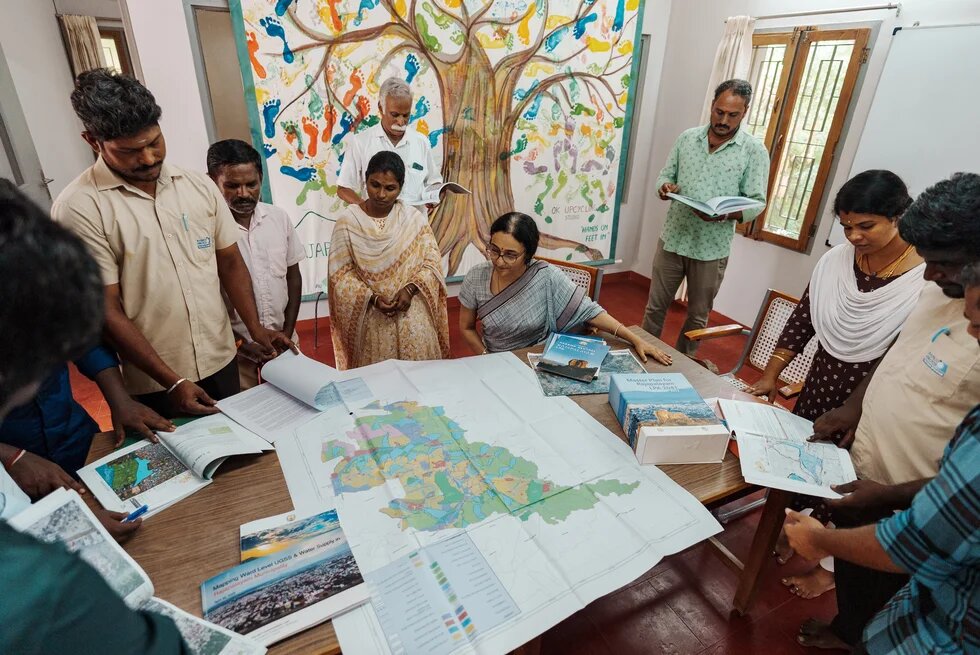
The town itself was undergoing significant changes under a master plan, as Rajapalayam had been selected under the Atal Mission for Rejuvenation and Urban Transformation (AMRUT). Roads were being dug up, infrastructure was shifting, and people were struggling to make sense of what was happening. Through their deep engagement with the community, Atmaprasara volunteers began to surface these anxieties and questions. It was through their insights and relationships on the ground that we recognised an opportunity to engage with the master plan more meaningfully, leading me to work more closely with local governance and planning processes.
Around this time, I was introduced to Tamil Nadu’s additional chief secretary Supriya Sahu who heads the Department of Environment, Climate Change and Forests. For me, she was not only an entry point into understanding climate policy, but also a role model who showed how leadership within government can drive meaningful environmental action. Through those interactions, I began to see how local realities connect to larger climate frameworks.
NS
One of the significant contributions from Rajapalayam has been the greenhouse gas (GHG) inventory. Could you tell us about that process and what it revealed?
NR
The GHG inventory was an important step for us because it allowed us to move from intuition to evidence. We worked on understanding where emissions were actually coming from within the town.
What emerged very clearly was that stationary energy electricity used in homes, buildings, and industry was the largest contributor. That was a powerful insight because it shifted the focus of where action was needed.
Rajapalayam is an old town with a dense, continuous built environment. But at the same time, almost every rooftop holds potential. There is a real opportunity for decentralised solar, especially rooftop solar.
The question then becomes: How do we make that transition possible? It’s not just about technology it’s about awareness, trust and demonstration. People need to see it working to understand its value. That’s where pilot projects and community engagement become very important.
NS
Your work in Rajapalayam from mine restoration in 2019 to enabling the GHG inventory in 2021, alongside your role as a member and powerful policy voice on the Tamil Nadu Climate Change Mission Governing Council feels deeply rooted in place and spans practice to policy. What have you learned from building something like this over time?
NR
One of the most meaningful parts of this journey has been the restoration of the Pandalgudi limestone mine, a site that had been extensively mined and left ecologically degraded.
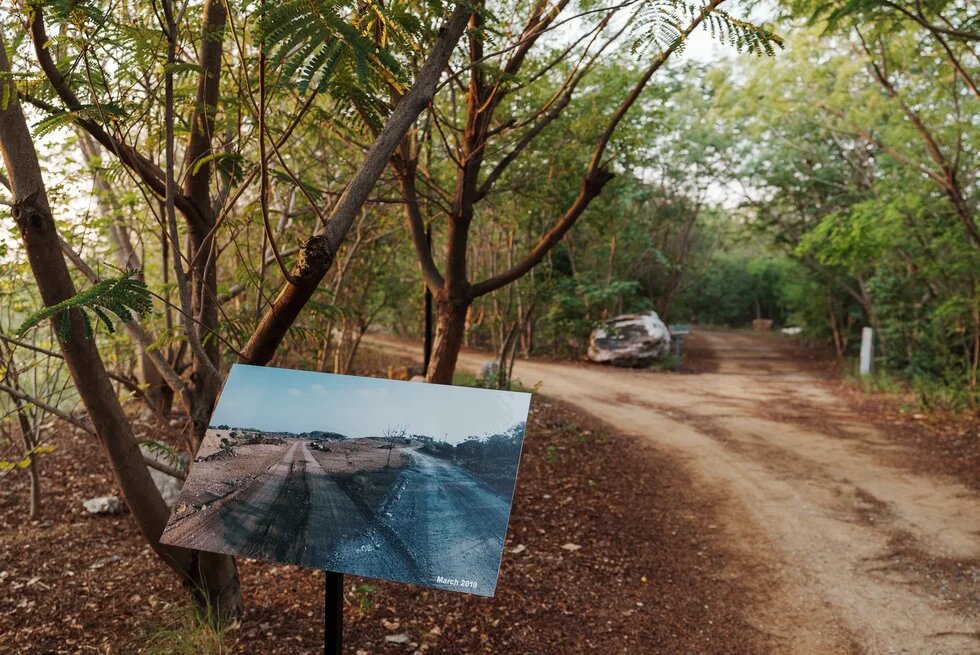
When we first began, the land was harsh and almost lifeless with high lime content, with no topsoil and visible vegetation. The approach we took was slow and deliberate – studying the soil, reintroducing native species, improving moisture retention, and allowing natural processes to regenerate the land over time.
We started with about 60 acres, carefully observing what would survive and adapt. Over the years, this expanded to several hundred acres. Today, the landscape supports a wide diversity of native plants over 100 species and has begun to attract birds, insects, and other life back into the ecosystem.
It has evolved into what is now an eco-restoration park, a space for learning, reflection, and demonstrating what is possible when degraded land is given time and care to heal. The work has also drawn wider public attention. Tamil Nadu chief minister M.K. Stalin and finance minister Thangam Thennarasu (also in charge of environment and climate change), visited the site and commended these efforts. There is now growing recognition that Rajapalayam offers a kind of living master plan, one that can be adapted and replicated where the learning from this restoration can inform templates for rehabilitating mined landscapes across Tamil Nadu, alongside a more comprehensive study of mines in the state.
For me, this work is not just about restoring one site. It is about asking a larger question: How many such landscapes exist, especially in mining areas and how can we reimagine them to benefit communities living alongside the mines?
NS
You’ve stepped into spaces such as industry, policy and infrastructure planning that are often male-dominated. What has it meant to be a woman in those decision-making areas?
NR
I have often found myself in rooms where there are very few women. In the beginning, there can be hesitation both from others and from within yourself. Your work may even be seen as a “hobby” before it is taken seriously.
But over time, what matters is consistency – showing up, doing the work, building credibility.
I strongly feel that when women are part of decision-making, the nature of decisions changes. There is often a more holistic way of thinking, an ability to hold multiple perspectives, to consider long-term impacts, to connect the social, emotional, and ecological dimensions.
Women also tend to build support systems for one another. When that happens, the impact multiplies.
NS
When you think about the scale of transformation needed today, especially in the energy transition, what gives you hope?
NR
What gives me hope is seeing how change can emerge when different pieces –community, government, industry – come together.
And increasingly, I see women playing a very important role in that. Not just as participants, but as leaders, decision-makers, and connectors.
Energy transition is not only a technical shift; it is also a social one. It requires trust, collaboration, and care. These are qualities that many women already bring into their work and lives.
If we can create more space for women in decision-making, I believe we will see deeper, more meaningful change.